What a NAP Citation Actually Is
NAP stands for Name, Address, Phone. A NAP citation is simply your business details appearing anywhere online, and it comes in two forms. Structured citations live in dedicated fields on directories: Yelp, Yellow Pages, Facebook, Bing Places, and the data aggregators that feed hundreds of smaller sites. Unstructured citations appear in running text: a local news story that mentions your address, a supplier page that lists your phone number, a blog roundup of local businesses.
What makes or breaks a NAP citation is consistency. Your business name, address, and phone number must read exactly the same everywhere. Small differences cause real problems: using "St" on one site and "Street" on another, dropping a suite number, or listing an old phone number after you switch providers. Google's business profile guidelines stress accurate, consistent information, and every mismatched listing is a small vote against your trustworthiness. Fix the variations before you build anything new.
What a Google Map Citation Is
A Google Map citation is a listing that goes one step further than text. Alongside your NAP details it embeds an interactive Google Map showing your location as a pin, and it usually links out to your Google Business Profile or your Google Maps place page. You find these on local directories, "near me" style websites, and niche directories that want visitors to see exactly where each business sits.
Do not confuse this with your Google Business Profile itself. Your profile is your own listing; a map citation is someone else's page pointing to your location on a map. That distinction matters, because a directory that embeds a map has taken an extra verification step. Scraping text is cheap. Pinning your real location on Google's map tells Google the directory checked where you actually operate.
The Real Difference, Side by Side
Both types of citation mention your business, but they prove different things. Here is how they compare:
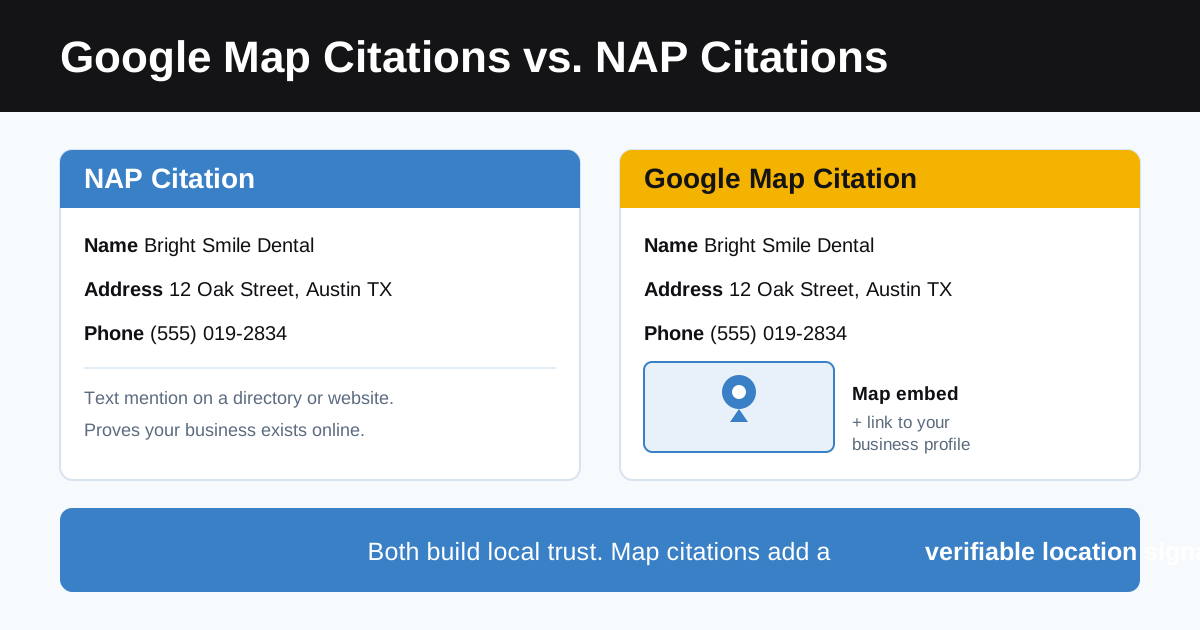
- Content: a NAP citation is text only. A map citation is NAP text plus an embedded map pin, usually with a link to your business profile.
- What it proves: a NAP citation shows your business exists online. A map citation confirms where it physically sits.
- Ranking weight: NAP citations are foundational and supportive. Map citations carry a stronger local trust signal because Google can match the pin against your listed address.
- How common they are: plain NAP listings are everywhere. Map citations are rarer, which is part of why they stand out.
Think of it this way: a NAP citation says "this business exists." A map citation says "this business exists, and here is proof of where." Google cares deeply about the second part, because location is the backbone of every Maps result.
Why Map Citations Often Push Rankings Harder
Local SEO practitioners consistently report that map citations correlate with stronger Maps visibility, and the mechanism is straightforward. When a directory embeds a map, Google can verify that the pinned location matches the address on your Google Business Profile. That cross-check reinforces the relevance and proximity signals that decide who shows up in the Map Pack.
There is also an engagement angle. Pages with embedded maps earn direction requests, taps, and dwell time from users planning a visit. Those interactions signal to Google that real people find the location useful. None of this means citations work alone. A flawless citation profile will not rescue a thin Google Business Profile with no reviews, so keep your review strategy and profile optimization moving in parallel with efforts to improve your Google Maps ranking.
How to Build Both Types Without Wasting Time
Work in this order and you will not redo anything:
- Lock one canonical NAP. Decide the exact business name, street address, and phone number. If you operate in several cities, standardize the format before you list the second one, a discipline we cover in our guide to ranking in multiple locations.
- Claim the big structured listings. Google Business Profile, Apple Business Connect, Bing Places, Facebook, and Yelp. These are free and they matter most.
- Cover the data aggregators. A handful of aggregators distribute your NAP to hundreds of downstream directories, so one correct submission cleans up many listings at once.
- Hunt map citations deliberately. Search your niche plus your city and look for local directories and review sites that embed maps. Submit where they accept listings, and make sure the pin lands on your real address.
- Earn unstructured mentions. Local sponsorships, supplier partner pages, and community news coverage produce natural NAP mentions that no directory submission can fake.
- Clean up after any move. An address change means updating every citation, not just your website. Stale listings are worse than none at all.
The Mistakes That Make Citations Useless
Most citation problems are self-inflicted. Listing a virtual office or PO box instead of a real location violates Google's guidelines and can get your profile suspended. Building hundreds of low-quality directory submissions in a weekend creates duplicates you will spend months removing. And the classic: changing your address or phone number and leaving the old details live on thirty sites, telling Google two different stories about where you are.
Duplicates deserve special attention. Two listings for the same business split your trust signals and confuse customers who call the wrong number. Claim and merge them rather than ignoring them. If this feels like more plumbing than marketing, that is exactly what citation management is for: quiet, systematic accuracy work that compounds into visibility over time.