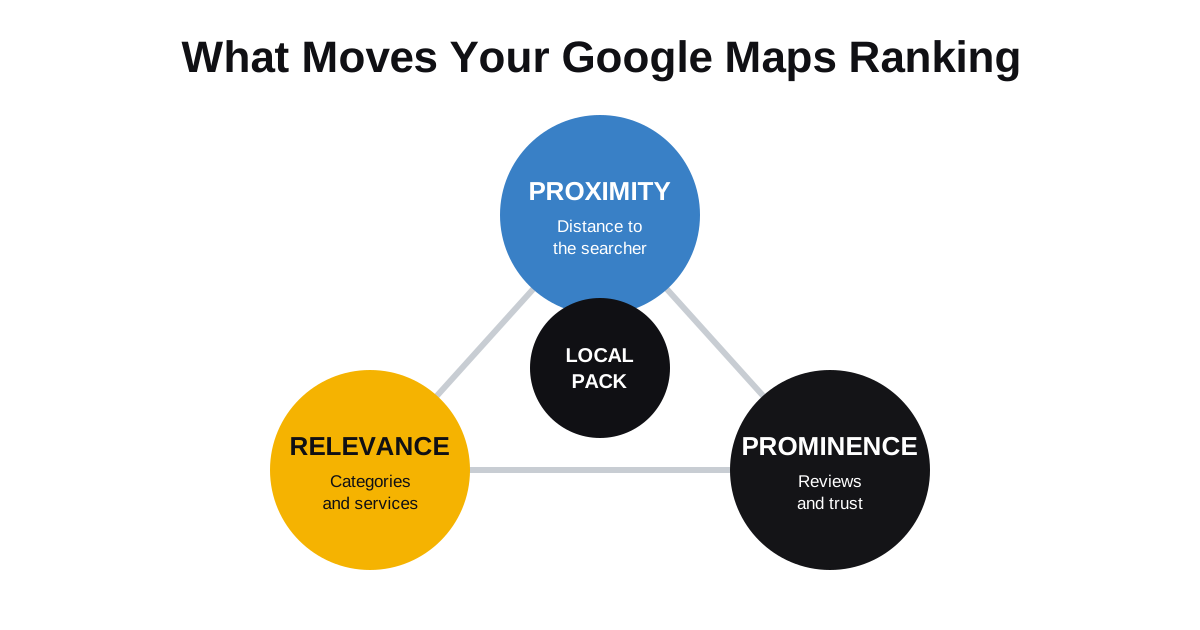
How Google Decides Who Ranks in the Local Pack
Google has said publicly that local results rest on three signals: proximity (how close your business is to the searcher), relevance (how well your profile matches the search), and prominence (how well known and trusted your business is). Notice that proximity is mostly geography. Someone searching two streets away often sees a different map than you do.
You cannot move your address, but the other two levers are fully in your hands. Relevance comes from your categories, your services, and your description. Prominence comes from reviews, ratings, photos, website links, and mentions of your business across the web. Most local businesses win by tightening relevance and steadily building prominence. That is what the rest of this guide covers, step by step.
Choosing Categories That Match What Customers Search
Your primary category is the strongest relevance signal you control. Pick the one that matches your main service. A plumber should choose "Plumber", not "Home Improvement Store" or "General Contractor". Think of it like a phone book: the right category puts you on the right page, and the wrong one hides you.
You can add up to nine additional categories, but add only services you genuinely offer. A vague or wrong primary category confuses Google about what you do, and it costs you rankings for the searches that matter most. To sanity-check your picks, search your main keyword, open the top three profiles in the local pack, and look at which primary category they use. If all three agree, follow their lead.
Completing Every Field on Your Profile
A thin profile gives Google little to match against. Fill in everything: accurate hours (update your holiday hours too), your full service list, a plain-language business description, and every attribute that applies, such as wheelchair access or free Wi-Fi.
- Photos: upload real exterior, interior, team, and work photos. Listings with photos get noticeably more clicks and calls, according to Google's own reporting.
- Verification: if your profile is not verified, verify it. Unverified businesses rarely rank well and cannot fully control their own information.
- Hours: wrong hours lead to locked doors, frustrated customers, and one-star reviews. Keep them accurate all year.
Completeness is not a one-time chore. Revisit your profile each quarter and refresh anything that changed: new services, new photos, new hours. Stale details quietly undo your other work.
Reviews Are the Loudest Ranking Signal You Control
Review count, average rating, and how recently reviews arrive all feed prominence. A business with 80 recent reviews almost always outranks a similar one with 8 old ones. The good news is that asking is simple. The method that works best is boring: send a short text or email with your review link right after a job goes well.
- Reply to every review, good and bad. A short, polite response shows customers you are listening, and it keeps your profile looking active.
- Answer bad reviews calmly, without arguing. Future customers read your replies more carefully than the complaint itself.
- Never buy reviews or pay for positive ones. It violates policy and can get your profile suspended.
Do not be discouraged by an occasional one-star review. A believable mix of ratings, with thoughtful replies, builds more trust than a perfect score nobody believes.
Posts, Photos, and Q&A Keep Your Profile Looking Alive
Fresh activity signals an open, operating business. Publish short posts about offers, events, new services, or seasonal tips. Add new photos every few months. These are small signals on their own, but together they separate an active profile from a dormant one.
Pay attention to the Q&A section. Anyone can post questions on your profile, including competitors, and Google does not always notify you. Check it monthly, answer questions yourself, and seed the ones you hear most often: your hours, parking, services, and service areas. A profile that answers its own questions looks cared for, and it stops misinformation from taking root.
Your Website and Citations Back Up Your Profile
Google cross-checks your information across the web. Your business name, address, and phone number should match exactly on your website, your social profiles, and every directory. A suite number here or an old phone number there weakens trust in all of them, so pick one version and stick to it.
Build listings on the directories that matter in your industry: Yelp and Facebook for most local businesses, trade-specific sites for your niche, and your local chamber of commerce or business association. A relevant website helps too: it should state plainly what you do and where you do it, and link back to your profile. For the bigger question of covering more than one town, read our guide on ranking in multiple locations with local SEO, and see how we handle Google Business Profile optimization at iRankers.
Tactics That Will Get Your Profile Suspended
Shortcuts tempt every local business owner, but most of them end the same way: a suspended profile and weeks of recovery. Use your real business name everywhere. Adding keywords to it, like "Joe's Plumbing, Best Plumber in Chicago", violates policy and is one of the most common suspension triggers.
Fake addresses, virtual offices, and PO boxes are also against the rules, and one profile per real location is the limit. Duplicates built to dominate the map usually get merged or suspended. If you are ever suspended, the path back is slow: fix the violation, gather proof, and appeal. Prevention costs far less than recovery.