How Google Decides Who Ranks Locally
Local rankings run on three signals: proximity (how close the searcher is to the business), relevance (how well the listing matches the query), and prominence (reviews, links, and citations).
The distinction most businesses miss is between the map pack and organic local results. The map pack, those top three map listings, is overwhelmingly a proximity game. Industry ranking-factor studies have consistently placed proximity signals at the top for map-pack results year after year. Organic results below the map are far more flexible, and a well-built location page can outrank physically closer competitors there.
So ranking in multiple locations is really two different battles. Your strategy depends on which one you are fighting, and most businesses need to fight both.
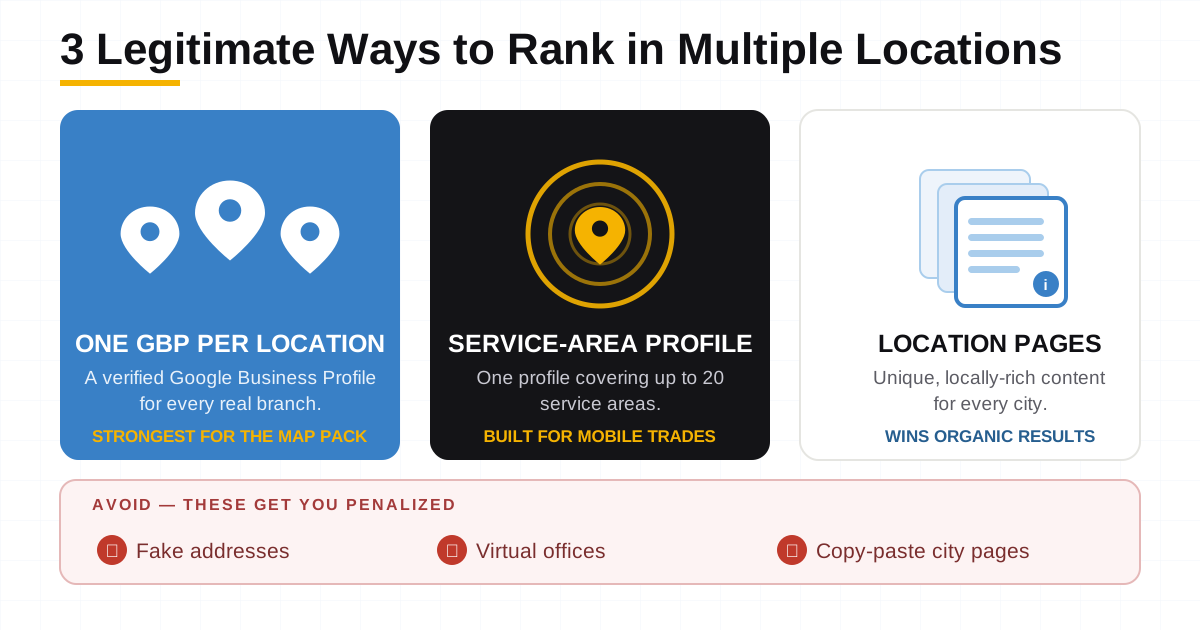
Method 1: One Google Business Profile Per Real Location
If you operate genuine offices, stores, or staffed branches in multiple cities, each one earns its own verified Google Business Profile. This is the strongest setup available, because each listing can rank in its own city's map pack independently.
Google enforces real requirements here, not suggestions. Each location needs:
- A genuine, staffed address.
- Its own phone number wherever possible.
- Location-specific reviews, photos, and posts rather than content duplicated across listings.
- Consistent NAP (name, address, and phone) across your website and citations for every location.
This is also the most demanding route. Each location needs its own review acquisition, citation building, and content effort. It pays off where the revenue justifies it, and for most multi-city businesses that means prioritizing high-value locations first rather than launching everywhere at once.
Method 2: A Service-Area Business Profile
Businesses that travel to customers, plumbers, electricians, cleaning companies, and similar trades, can hide their address and define up to 20 service areas on a single profile.
Be honest about the limits of this setup. A service-area listing can rank across its defined areas, but it still has one anchor point, and Google knows roughly where the business is based. Proximity still applies. A service-area business based in Lahore will struggle to own the map pack in Karachi against competitors physically located there. Where service-area profiles win most reliably is in organic results for surrounding towns, supported by strong location pages, which brings us to the third method.
Method 3: Location Pages That Actually Rank
This is the method most businesses attempt, and where most fail. A location page can rank in a city's organic results without a physical presence there, but only if it works as a genuine local resource rather than a doorway page.
Location pages that rank share the same traits:
- Unique, substantive content per city: neighborhoods served, local landmarks, city-specific FAQs, and photos from real local work. Never find-and-replace text.
- Local proof: reviews from customers in that city and case studies from local jobs.
- Clean internal linking: each location page links to relevant service pages and back to a parent locations hub, forming a structure search engines can understand. Getting this architecture right is technical SEO as much as it is content.
What gets filtered is the familiar pattern of thirty near-identical pages with swapped city names. Google has grown very good at detecting these. They rarely earn a dramatic penalty. They simply get deindexed quietly, and you never rank at all.
What Gets Businesses Penalized
The shortcuts that consistently backfire are well documented:
- Fake suite addresses or virtual offices used to claim multiple profiles, the leading cause of mass listing suspensions.
- Keyword-stuffed business names, against Google's guidelines, and competitors report them routinely.
- PO boxes or coworking addresses without a genuine staffed presence.
- Review gating or fake reviews spread across locations, one bad location can poison trust in all of them at once.
Recovery from a suspension takes weeks, and reinstatement is never guaranteed. The three legitimate methods above are slower, but their results compound instead of collapsing.
Building Prominence Across Every Location
Relevance and proximity get you considered. Prominence decides whether you win. Each location needs its own stream of genuine customer reviews, its own local citations, and ideally links from locally relevant sources such as chambers of commerce, local news, or community organizations. A single strong backlink profile pointing only at the homepage does not distribute authority to location pages the way many businesses assume. Location-level link building and citation work is what separates businesses that rank in one city from those that rank in five.
How Long Multi-Location Local SEO Takes
With consistent work, expect realistic timelines rather than promises:
- Single new location page: 2 to 4 months to start ranking for low-competition local terms.
- New profile in a competitive city: 3 to 6 months for map-pack visibility.
- Full multi-city rollout across five or more locations: 6 to 12 months before the system starts compounding.
Anyone promising page one in thirty days across multiple cities is selling one of the penalized shortcuts described above.